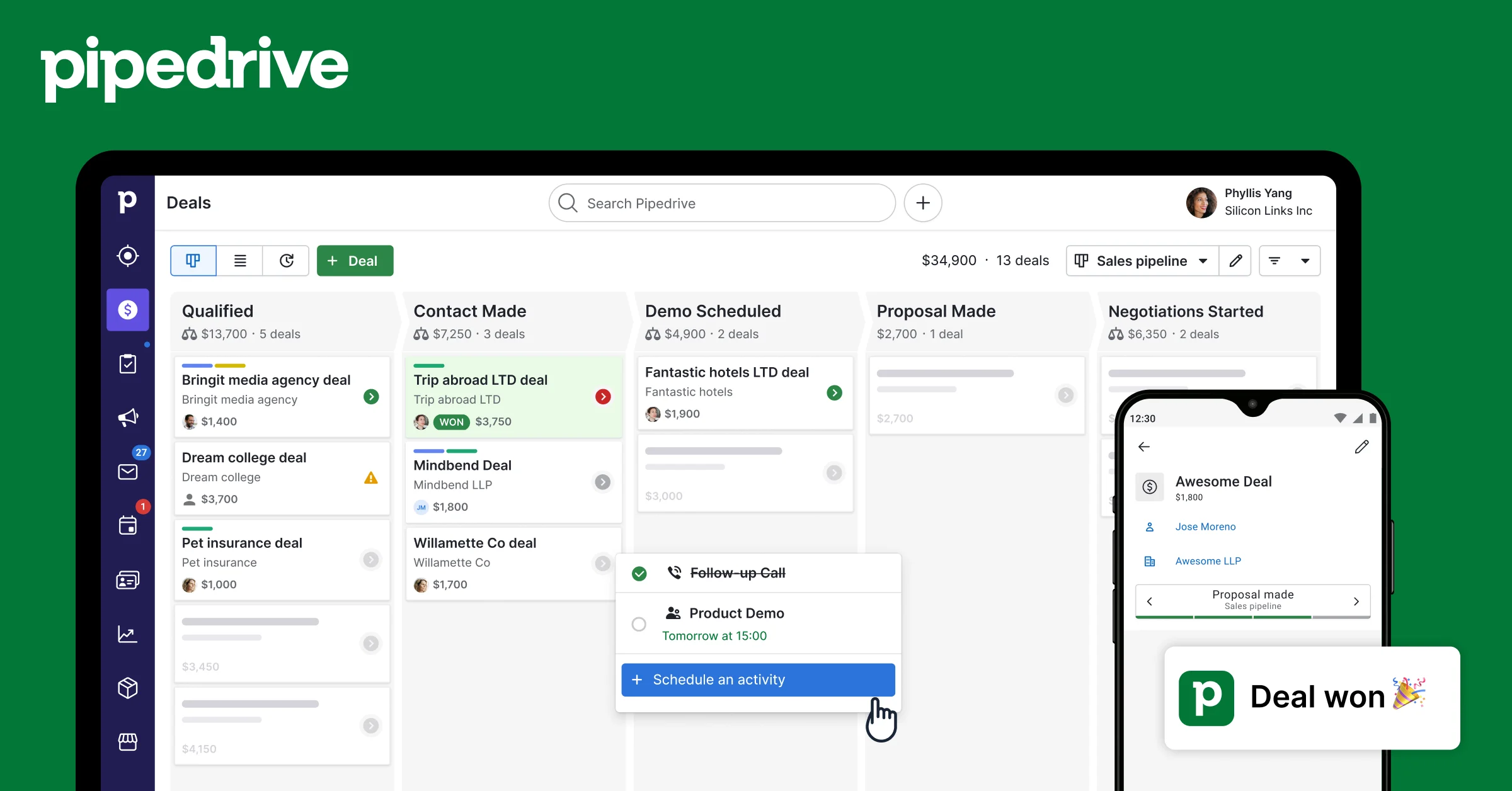
Pipedrive pulls ahead once sales reps need a CRM they will actually keep updated.
Reps update the spreadsheet instead.
Pipedrive leads on this page because setup risk and proof checks are clearer for the main process.
Budget and complexity split the choice: Pipedrive adds depth; Close CRM stays safer where calling and follow-up speed drive the sales day.Check pricing and pipeline setup.
Before choosingRun the next pipeline review before standardizing. Use Pipedrive for the full CRM test; keep Close CRM close if lighter upkeep keeps the team current.
Decision first, your case check second, proof only where the tradeoff is still unclear.
Choose it if
Pipedrive fits if can carry a small sales team for years before territory rules and manager reporting become painful.
Do not choose it if
pipeline lead adds upkeep before the team has a clear lead.
Best alternative
Close CRM: Close CRM fits if teams where calling and follow-up speed drive the sales day.
Why trust this
Budget and complexity split the choice: Pipedrive adds depth; Close CRM stays safer where calling and follow-up speed drive the sales day.
See the sales work each CRM covers
These visuals show whether the CRM helps with pipeline work, handoffs, reporting, and the admin reality that appears after adoption.
Sales Coverage
How much of the sales routine each CRM can carry
This score maps visible CRM capability across pipeline, handoff, forecasting, automation, setup, and reporting. It is not a live sales-performance metric.
Pipedrive86%
Pipedrive can carry most of this workflow, but the buyer should still verify limits, pricing, and handoff habits.
Close CRM78%
Close CRM is better read as a specialist or partial fit here; the remaining workflow needs another product or process.
HubSpot CRM92%
HubSpot CRM can carry most of this workflow, but the buyer should still verify limits, pricing, and handoff habits.
Use it to see whether the CRM can carry the operating routine or whether a second tool/process will still own the gap.
Work covered
What sales work the CRM replaces
Read this as the implementation path the CRM must support before the team can trust the pipeline.
Pipedrive
Import
Pipeline
Follow up
Review
Close CRM
Call
Email
Pipeline
Follow up
HubSpot CRM
Capture
Nurture
Handoff
Pipeline
Report
CRM Work Coverage
Where each CRM is strongest
Each bar is a product-fit signal for that sales surface. High scores still need validation against fields, permissions, reports, and adoption habits.
Pipedrive
Pipeline94%
Handoff58%
Forecasting62%
Automation58%
Setup88%
Reporting66%
Close CRM
Pipeline82%
Handoff70%
Forecasting52%
Automation72%
Setup78%
Reporting58%
HubSpot CRM
Pipeline82%
Handoff96%
Forecasting70%
Automation78%
Setup88%
Reporting84%
Product Reality
What tends to annoy teams later
Pipedrive
Pipedrive is easy to adopt, but managers can outgrow reporting, automations, and forecasting depth.
Close CRM
Close is strong for sales activity, but teams needing broader marketing and executive reporting should test depth.
HubSpot CRM
HubSpot starts simple, but hub tiers, seats, contacts, and migration depth can make it hard to leave.
Operational pattern
What usually happens after the shortlist
These are not invented case studies. They are buyer patterns to check before the tool becomes part of the weekly work.
Situation
The team wants one CRM to carry contacts, pipeline updates, follow-ups, and management reporting.
What happens first
The board looks cleaner quickly because stages and dashboards are easy to rebuild.
What surprises teams later
Duplicate fields, stale activities, and unclear owners usually follow the migration into the new system.
Mature decision
Select the CRM only if reps keep the record current during a real weekly review without rebuilding the truth in a spreadsheet.
CRM operational reality
The real CRM choice shows up after setup, when pipeline upkeep, reporting trust, ownership, and admin cleanup become weekly work.
Product
Pipeline upkeep
Reporting trust
Admin load
Best owner
Cost after buying
Pipedrive
Low
Medium
Low
Sales owner
Reporting ceiling
Close CRM
Low
Medium
Low
Calling-led sales team
Channel coverage limits
HubSpot CRM
Medium
Strong
Medium
Marketing and sales ops
Handoff sprawl
Zoho CRM
Medium
Medium
Medium
Ops-minded SMB
Configuration upkeep
Freshsales
Low
Medium
Low
SMB sales lead
Suite fit checks
Proof to check before buying
Pipedrive vs Close CRM Close CRM remains credible only if lighter sales routine removes more cleanup than it creates after setup.
Pipedrive earns the first test when week-three pipeline review still needs one owner.
Pipedrive helps teams when sales reps need a CRM they will actually keep updated.
Pipedrive keeps the next pipeline review owned without adding more cleanup.
What the team is really choosing
Pipedrive fit
Use Pipedrive if fits if can carry a small sales team for years before territory rules and manager reporting become painful.
Close CRM fit
Use Close CRM if fits if teams where calling and follow-up speed drive the sales day.
Where Pipedrive gets risky
Pipedrive gets risky when pipeline ownership adds upkeep before the team has a clear owner.
Where Close CRM gets risky
Close CRM gets risky when admin overhead slows adoption before the routine creates relief.
Pipedrive leads on clean sales pipeline updates; Close CRM is safer for calling and follow-up speed.
The wrong choice appears when Close CRM owns the real task.
Why teams keep using Pipedrive
Pipedrive fits teams whose reps need a CRM they will actually keep updated.
What survives after setup
Pipedrive keeps simple pipeline management and sales activity tracking cleaner once one owner owns the first review cycle.
When the lighter path still works
Close CRM remains credible only if a lighter routine still survives the first cleanup cycle.
Where the work still has an owner
When the routine still has an owner
Close CRM remains credible only if the lighter routine still survives the first review cycle.
Evidence, FAQ, and related decisions
Derived signal: Trust for CRM workflow decision depends on official source coverage, current pricing, product-specific evidence, and visible tradeoffs.
How the choice changes
PipedriveCRM software
Winner
Where it leads
Pipedrive
Best moment: sales reps need a CRM they will actually keep updated.
Watch out: avoid when reporting and controls outgrow the simple pipeline.
✔ Evidence limits: this snapshot does not publish separate proof-point metadata.
What survives normal use
Pipedrive fits teams whose reps need a CRM they will actually keep updated.
After the setup weekPipedrive earns the lead as clearest proof path for pipeline owner, follow-up discipline, reporting, and sales handoff.Where the pattern holdsPipedrive pulls ahead once sales reps need a CRM they will actually keep updated.The field testPipedrive was measured against Close CRM across 18 scenarios.
Evidence by tool
The wrong choice appears when Close CRM owns the real task.
PipedriveCRM software
Reporting trust usually breaks before the dashboard does.
The weekly work depends on clearest proof path for pipeline owner, follow-up discipline, reporting, and sales handoff.
The process breaks down when automation, quoting, service process, or enterprise control is the real bottleneck.
The wrong choice creates pipeline hygiene work that sales teams stop trusting.
Close CRMCRM software
The pipeline breaks when nobody owns the next step.
The weekly work depends on automation, quoting, service process, or enterprise control is the real bottleneck.
The process breaks down when the buyer needs the broader default path.
The wrong choice creates pipeline hygiene work that sales teams stop trusting.
HubSpot CRMCRM software
CRMs fail quietly before managers notice.
The weekly work depends on a narrower sales motion or operating model.
The process breaks down when the buyer needs the broader default path.
The wrong choice creates pipeline hygiene work that sales teams stop trusting.
Zoho CRMCRM software
Reporting trust usually breaks before the dashboard does.
The weekly work depends on a narrower sales motion or operating model.
The process breaks down when the buyer needs the broader default path.
The wrong choice creates pipeline hygiene work that sales teams stop trusting.
Best adoption and job match: Pipedrive.
This map compares ease of adoption against job match. Use it to spot whether the winner is strong overall or whether a backup is better for a narrower workflow.
Ease of adoptionJob matchLow easeHigh easeWeak matchStrong match
PipedriveStrong adoption and job matchPipedriveEase 94 · Job 96
Strong adoption and job matchClose CRMEase 85 · Job 86
Moderate adoption and job matchHubSpot CRMEase 76 · Job 73
Moderate adoption and job matchZoho CRMEase 72 · Job 69
Moderate adoption and job matchFreshsalesEase 68 · Job 65
Moderate adoption and job matchSalesforceEase 64 · Job 61
Review basis
Scores use a 0-10 page-specific scale. The weighting starts with process fit, product evidence, observed usage patterns, and buyer consequences before price, support, and commercial tradeoffs.
Products
6
Workflows
20
Scenarios
18
Fit reviewed
20
Scale
0-10, page-specific fit score
Weighting
Workflow and buyer fit 40%; product evidence and source-backed capability 35%; price, support, migration, and commercial risk 25%
Buyer support
Buying FAQ
Focused answers for pricing, setup effort, alternatives, and the tradeoffs that usually appear after the first shortlist.
Where does Pipedrive make sense?
Pipedrive gives pipeline and transfer check clearer lead after setup.
When does Close CRM stay useful?
Close CRM still matters once the lighter sales routine keeps pipeline reviews current without adding cleanup.
What should buyers check first?
Check who owns the next review and which routine the team will keep current.
What usually breaks after CRM setup?
The first failure is usually lead.
When is Close CRM better than Pipedrive?
A lighter CRM is better for reps can keep the pipeline current with less admin.
What should sales teams test before buying a CRM?
Test one pipeline lead, one cleanup pass, one transfer, one manager review, and one week of rep updates.